- · When a single customer represents more than 20% of revenue, institutional buyers apply a formulaic 10–25% valuation discount — and most owners only learn this at the letter-of-intent stage.
- · Above 40% concentration, deals frequently fail outright; above 25%, structural protections such as earnouts and escrow holdbacks become near-standard.
- · Customer concentration ranks as the second-largest source of valuation discount in lower-middle-market M&A, behind only EBITDA quality issues.
- · A documented 12–24 month diversification trajectory is materially more persuasive to buyers than any static snapshot, however recent.
There is a particular variety of due-diligence conversation that acquisition professionals find uncomfortable to initiate — not because the information is surprising to them, but because it is invariably surprising to the seller. It occurs somewhere between the non-disclosure agreement and the letter of intent, and it involves a number the owner has known for years without recognising its significance: the percentage of revenue attributable to their single largest customer.
LockRoom's 2026 analysis of lower-middle-market transactions identified customer concentration as the number-two source of valuation discount in this segment, trailing only EBITDA quality concerns. The finding is consistent with practitioner observation across the sector. As Fisart's valuation research notes, a single customer representing more than 20% of revenue typically cuts a business valuation by 10–25% in diligence — and the owner generally discovers this at the LOI stage, not before.
The timing matters. By the LOI stage, the seller has invested months in process preparation, management presentations, and commercial disclosure. The leverage has shifted. The discount, at that point, is no longer theoretical.
Buyer behaviour on this point is not discretionary. It is formulaic. Mid-Market Advisory describes the threshold at which elevated risk classification is triggered: any single customer above 20% of revenue. Beyond 30%, deal structure changes — earnouts, escrow holdbacks — become standard rather than exceptional.
The progression is worth understanding precisely. Under 10% per customer, no discount is typically applied and competitive tension among buyers remains intact. Between 10% and 20%, buyers pay closer attention and minor discounts or structural negotiations may emerge. Between 20% and 35%, the valuation discount range of 10–25% becomes applicable, with earnout and escrow protections likely. At 25% or above, the discount range shifts toward 15–30% and becomes increasingly mechanical in application. At 40% or above, the deal-killing risk is material; most institutional buyers withdraw unless the customer relationship is contractually embedded and operationally arms-length.
The underlying logic is not punitive. It is actuarial. Glacier Lake Partners frames it with useful precision: one customer at 35% of a CHF 5 million revenue business creates between CHF 1.05 million and CHF 2.1 million in enterprise value discount through lower multiple, escrow, or earnout — before the first negotiation session. A buyer closing at 6x EBITDA on that business is not confronting a 35% problem. It is confronting a deal-structure adjustment of that magnitude that reduces cash proceeds at close.
The phrasing used in acquisition circles is pointed. Mfrow's acquisition analysis articulates it plainly: a business earning 60% of its revenue from one customer is not a business — it is a subcontractor. The buyer is not acquiring an enterprise. It is acquiring a renewal risk.
A common owner response to concentration concerns is to produce the long-term supply agreement. The instinct is understandable. A three-year contract with automatic renewal provisions does represent something. Buyers acknowledge it. They do not, however, treat it as adequate mitigation.
The institutional concern is not legal enforceability. It is relationship portability. The question a diligence team is actually asking is whether the customer relationship is company-facing or person-facing. If the founder is the account, and the founder exits at close, the contract's terms become considerably less relevant than the underlying relationship goodwill — which has just walked out the door.
This dynamic is also visible in acquisition financing. Mfrow's research cites SBA lender surveys and the IBBA Q4 2024 Market Pulse report to note that customer concentration is the single most commonly cited reason lenders decline SBA acquisition loans. Financing markets and equity buyers are, on this point, aligned.
The penalty is not uniform across industries. It falls most heavily on B2B services, software, and subcontracting models, where customer relationships are by nature relationship-dependent and switching costs are asymmetric. Asset-heavy businesses with contractual revenue streams — industrial equipment suppliers with multi-year OEM commitments, for instance — face meaningfully less discount pressure, even at similar concentration levels.
The distinction buyers are drawing is between relationship-embedded revenue and contractually-embedded revenue. A consulting firm deriving 40% of fees from one client sits in a fundamentally different risk category than a machinery manufacturer with 40% of revenue from a contractually committed customer that would face significant switching costs to move.
Context does not eliminate the discount. It calibrates it.
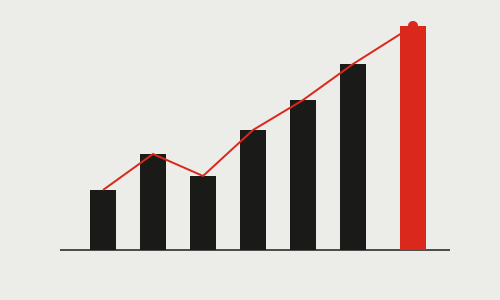
The most actionable observation in this area of M&A research is also the most underutilised by owners. A static snapshot of concentration — you are today at 35% from one customer — is a worse presentation to a buyer than a documented downward trajectory moving from 35% to 28% to 20% over eighteen months.
Mid-Market Advisory's research states this directly: a documented downward trajectory from 35% to 24% tells a fundamentally different story than a static snapshot. The trajectory is evidence of deliberate operator work: systematic new business development, account management discipline, intentional de-risking. The static snapshot invites questions that sellers generally prefer not to answer under diligence conditions.
This is the structural argument for a three-year preparation window. Owners who audit their top-ten customer concentration in year one, establish documented sales goals in year one through two, negotiate multi-year contracts with their top customers in year two, and build customer-agnostic operational processes in year two through three, enter the market with a trajectory rather than a problem. In the twelve months before going to market, commissioning customer due-diligence interviews with the top five accounts to surface loyalty, competitive risk, and post-acquisition continuity comfort is a further step that serious buyers notice and reward.
Not every owner has a three-year runway. For those entering the market with concentration above the comfortable thresholds, deal structure becomes the primary mitigation tool.
Earnouts tied to customer retention allow sellers to receive additional consideration if the key customer is retained through the earnout period, while absorbing a portion of the loss if it is not. Extended escrow holdbacks — typically 10–25% of purchase price held for 12–24 months against customer defection — serve a similar function from the buyer's perspective. Management retention agreements, requiring the founder or senior account manager to remain through a defined transition period, address the person-facing relationship risk directly. Dual-track sale processes, running strategic buyers alongside financial buyers, can surface acquirers willing to pay a premium for synergies that offset the concentration discount.
None of these structures are optimal for sellers. All of them are preferable to a failed process.
Concentration risk in technology-sector acquisitions has drawn its own commentary. One perspective circulating in deal-professional networks:
If you're reading this, I trust the algorithm targeted you because you evaluate software companies for a living. Experienced deal teams love saying they run thorough diligence. I intend to show you why, for AI deals, they don't.§ @mardehaym
The observation sits within a broader debate about whether diligence practices in high-growth technology transactions have kept pace with the structural risks those businesses carry. Customer concentration is among those risks — and in software, where annual recurring revenue metrics can obscure single-customer dependency, it is one of the less visible ones until late in the process.
Customer concentration is among the most formulaic valuation adjustments in lower-middle-market M&A. It is applied consistently, its thresholds are understood by institutional buyers if not always by sellers, and its consequences at the negotiating table are significant. It is also, relative to many operational deficiencies, correctable — provided the owner begins the work early enough for the correction to register as a trajectory rather than a last-minute adjustment.
The preparation window is real. The discount is real. The timing of discovery, for owners who do not plan ahead, is reliably inconvenient.
This post reflects market observations drawn from published M&A research and lender surveys. It does not constitute financial, legal, or advisory guidance. LockRoom operates as a transaction venue; it does not act as an advisor to buyers or sellers.