- · The Praktikermethode, prescribed by Federal Tax Circular No. 28, is the formula Swiss cantonal tax authorities use to value unlisted SMEs for wealth, inheritance, and gift tax purposes.
- · It combines capitalized earnings value and net asset value in a fixed 2:1 ratio, and almost always produces a figure below what a competitive M&A process would achieve.
- · The gap between the statutory valuation and the market price reflects hidden reserves, EBITDA normalization opportunities, and strategic buyer premiums — collectively referred to as the "arbitrage gap."
- · Sellers and fiduciaries who understand the method before entering a transaction are better positioned to manage tax exposure and justify premium pricing to buyers.
For most Swiss SME owners, the Praktikermethode surfaces first as a line in a fiduciary's report, or as a figure cited by a cantonal tax authority during a wealth tax assessment. Its influence, however, extends well beyond the annual tax declaration. It sets the regulatory floor for succession discussions, informs gift and inheritance tax calculations, and provides the statutory reference point against which any private transaction will be scrutinized.
Understanding this formula is not optional for any party preparing a Swiss SME for sale or transfer. It is, in the most literal sense, the language the authorities speak.
The Praktikermethode is prescribed by Federal Tax Circular No. 28 (Kreisschreiben Nr. 28) and codified within Switzerland's broader statutory accounting framework under the Code of Obligations (OR 957/964). As described by Aurevis, the formula reads:
Enterprise Value = (2 × Capitalized Earnings Value + 1 × Net Asset Value) ÷ 3
The weighting is deliberate. Earnings power is counted twice because a going concern derives most of its value from its capacity to generate future profit. Asset backing counts once, providing a floor in scenarios where earnings are temporarily depressed or where the business holds substantial tangible property.
is derived by dividing a company's sustainable, normalized net profit by a capitalization rate. Normalization matters here: one-off income, above-market owner compensation, and non-operating costs are all adjusted out before the divisor is applied. The capitalization rate reflects the risk-adjusted return an investor would require. According to Aurevis, the Swiss Tax Conference publishes annual guidance under KS 28, with recommended rates ranging from 7.0% to 9.5% between 2020 and 2024. In private market transactions, however, buyers typically apply rates of 10% to 15%, reflecting the additional risk premium associated with owner-managed businesses and less liquid equity.
begins with a straightforward calculation: total assets minus total liabilities. The adjustment that makes it more complex, and considerably more important, is the inclusion of hidden reserves (stille Reserven). As Aurevis explains, hidden reserves arise when assets are carried on the balance sheet below their true economic value. Fully depreciated machinery still generating cash flow, inventory at acquisition cost, real estate purchased decades ago at a fraction of current market value: all of these create a gap between book value and economic reality. Deferred taxes, calculated on those temporary differences between the commercial and tax balance sheets, are then subtracted from the adjusted net asset figure.
The numbers below illustrate how the formula operates in practice, using a precision manufacturing company as the reference case.
The company posts CHF 100,000 in sustainable normalized net profit. Its balance sheet shows assets of CHF 1,000,000 and liabilities of CHF 200,000. Machinery is carried at a book value of CHF 350,000, but its market value is CHF 500,000, generating hidden reserves of CHF 150,000. Deferred taxes are estimated at CHF 30,000 (applying a 20% rate to the CHF 150,000 hidden reserve).
Applying a 14% capitalization rate, consistent with the private-market range cited by Aurevis:
Earnings Value = CHF 100,000 ÷ 0.14 = CHF 714,286
Net Asset Value = CHF 1,000,000 – CHF 200,000 + CHF 150,000 – CHF 30,000 = CHF 920,000
Praktikermethode Valuation = (2 × CHF 714,286 + 1 × CHF 920,000) ÷ 3 = CHF 782,857
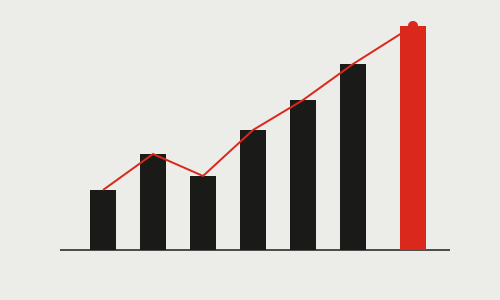
That same business, entering a competitive M&A process with transparent normalized financials, would be assessed by strategic buyers using EBITDA multiples. For stable manufacturing, market multiples of 6–8× are common, which would place the transaction value in the range of CHF 1.2M to CHF 1.5M. The statutory valuation of CHF 782,857 and the market valuation of CHF 1.2M to CHF 1.5M define the arbitrage gap — value that becomes visible only when the company is formally marketed to qualified buyers.
ValIndex observes that for a typical Swiss industrial SME, hidden reserves can represent 30–60% of additional enterprise value above book value. A company assessed at CHF 3.2M under the Praktikermethode may transact at CHF 5.5M in a competitive process. The formula, in other words, is a floor — not a ceiling.
A seller domiciled in a high-wealth-tax canton faces ongoing annual tax liability on the Praktikermethode figure. In a canton such as Geneva, where wealth tax rates can reach 1% annually, the difference between a precisely calculated statutory valuation and an inflated one is financially material year after year. This is not a post-transaction consideration — it applies continuously until ownership transfers.
Swiss cantonal tax authorities are alert to transactions that might constitute an indirect partial liquidation (partielle indirekte Liquidation, or PIL). If a buyer significantly strips assets or restructures the business immediately after closing, and the purchase price substantially exceeded the Praktikermethode baseline, authorities may examine whether the excess constituted a disguised asset distribution. A documented, defensible valuation reconciliation — one that explains the gap through clearly identified hidden reserves and normalized EBITDA — reduces that risk materially.
When a fiduciary works through the net asset value calculation in detail, hidden reserves emerge. Machinery that has been fully depreciated for years but continues to perform productively, property carried at 1988 acquisition cost in a market that has moved significantly since — these are not trivial adjustments. They are quantifiable, explainable, and relevant to buyers conducting due diligence. The Praktikermethode, applied rigorously, does some of the normalization work before the sales process begins.
The Praktikermethode earns its status as a benchmark because it is legally recognized, consistently applied across all twenty-six cantons, and understood by every Swiss tax authority. It demands explicit normalization of earnings and forces a structured view of the asset base. For a fiduciary preparing a valuation opinion, it provides a defensible, standardized framework.
Its limitations are also well understood. It is inherently backward-looking, anchored in historical earnings rather than forward projections. The fixed capitalization rates published annually by the Swiss Tax Conference may not reflect prevailing market conditions in any given year. And in sectors where earnings are growing rapidly, where assets are primarily intangible, or where the business model is innovation-intensive, the formula can produce figures that significantly understate economic reality. A software-as-a-service company with minimal tangible assets and strong recurring revenue will look considerably less impressive through the lens of a formula that weights net asset value at one-third.
For any seller preparing a business for transition, the discipline of running three parallel valuations before engaging with buyers is not procedural excess — it is necessary preparation.
The Praktikermethode floor establishes what tax authorities will assess and defines the minimum defensible figure in any statutory dispute. A discounted cash flow (DCF) analysis layers in forward-looking cash generation, capturing growth trajectories that the backward-looking Praktikermethode cannot. And a comparable transaction multiple analysis — drawing on actual deal data for businesses of similar scale, sector, and profile — reflects what strategic and financial buyers are genuinely paying in the current market.
The distance between the first figure and the third reflects the work that remains to be done before the business is sale-ready: hidden reserves to be quantified, earnings to be normalized, the strategic narrative to be assembled. A professional M&A process typically achieves outcomes 20–50% above the Praktikermethode baseline, depending on sector, growth profile, customer concentration, and the competitive dynamics of the buyer process. That range is not a guarantee — it is a market observation, and the outcome depends entirely on preparation.
The Praktikermethode will not tell a seller what their business is worth to a well-informed strategic buyer. What it will do is define the statutory baseline, surface hidden value in the balance sheet, and establish the regulatory reference point that any transaction must be able to explain. Sellers and fiduciaries who approach it as an inconvenient tax artifact rather than an analytical tool are leaving significant preparatory work undone.
Discretion · Precision · Permanence.