- · Swiss companies with revenue below CHF 5 million typically trade at EBITDA multiples 1.0x to 2.5x lower than mid-market peers, costing sellers CHF 300,000 to 600,000 on a CHF 3–4 million transaction.
- · The discount is structural, not cyclical — driven by owner dependency, customer concentration, institutional buyer inaccessibility, and weaker financial transparency.
- · Sellers who begin mitigation 2–3 years before exit can recover 30–50% of the penalty through targeted value-driver improvements.
- · Buyers sourcing off-market can enter at multiples amplified further by this discount, improving acquisition economics materially.
In Swiss M&A, size is not simply a descriptor. It is a pricing variable with measurable, repeatable consequences. A business generating CHF 500,000 in normalized EBITDA does not trade at the same multiple as one generating CHF 5 million — and the difference is not a matter of a buyer driving a hard bargain. It reflects a set of structural realities that compress demand, elevate perceived risk, and, ultimately, reduce what a seller receives at closing.
This post examines that discount in precise terms: what drives it, how large it is, and what corporate advisors, buyers, and sellers can do with that knowledge.
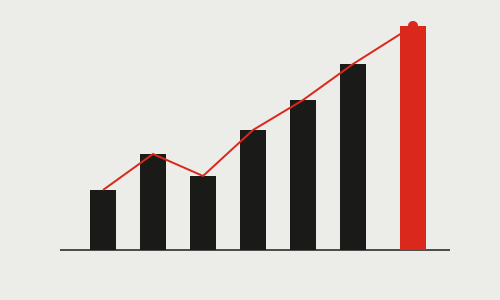
Current DACH market data (Q2 2026) illustrates the size premium across sectors with notable consistency. In IT Services, micro-cap businesses — defined as those with revenue below EUR 5 million — trade at EBITDA multiples of 5.7x to 6.8x. Small-cap peers in the EUR 5–50 million range command 6.8x to 8.5x, and mid-cap companies above EUR 50 million reach 7.8x to 10.2x. In Mechanical Engineering, the progression runs from 3.5x–4.5x at the micro-cap level, to 4.6x–6.0x for small-caps, to 5.6x–7.1x at mid-market scale.
As Deal Origination's DACH EBITDA multiples analysis observes, "the size discount reflects lower diversification and restricted access to institutional buyers, pulling the multiple 1.0x to 2.5x below the large-company benchmark."
The mathematical effect is concrete. Take a normalized EBITDA of CHF 500,000. At a micro-cap median multiple of 5.5x across sectors, the enterprise value is CHF 2.75 million. Apply a small-cap median of 6.5x to the same earnings figure, and the value rises to CHF 3.25 million. That CHF 500,000 difference — an 18% variance — is generated by size classification alone, not by any change in underlying profitability or business quality. For a transaction in the CHF 3–4 million equity range, this translates to a value gap of CHF 300,000 to 600,000.
This is not volatility. It is structural.
Understanding the discount requires understanding its component parts. There are four, and each carries its own valuation weight.
Private equity platforms, family offices, and strategic acquirers with formal capital deployment mandates generally require minimum deal sizes that exclude micro-cap transactions. A business with revenue under CHF 5 million sells predominantly to owner-managers or high-net-worth individuals. The resulting demand pool is shallow, and shallow demand means compressed pricing. Larger businesses attract competitive, multi-party processes — and competitive processes produce premium multiples.
A company in which the retiring founder holds primary client relationships, operational knowledge, and internal authority is a company whose value is partly non-transferable. Buyers price this risk as a multiple drag of 0.5x to 1.5x. Mid-market companies, by contrast, typically have professional management structures in place that survive a founder's departure without disruption to revenue or operations.
Smaller businesses are statistically more exposed to revenue concentration. A single customer representing more than 20% of annual revenue is a visible risk flag for any informed buyer, and it carries a measurable multiple penalty. Larger companies tend to have diversified customer bases, distributing that risk across a wider set of relationships.
Smaller Swiss businesses frequently operate with restricted audits or review-level financial statements. Larger companies maintain full financial audits, which provide buyers with the confidence required to underwrite a transaction at a higher multiple. Reporting quality is not a bureaucratic formality — it is a direct input into buyer certainty and, therefore, into price.
The Swiss context adds a further layer of complexity. As Valindex's guide to Swiss SME valuation notes, the WACC for Swiss SMEs typically ranges from 12% to 18%, reflecting both illiquidity and the size premium embedded in smaller owner-managed businesses. This compares to 8–12% for mid-market peers — a 3–6 percentage point spread in discount rate that compounds materially when applied to projected cash flows.
Switzerland's conservatively structured accounting framework creates a further dynamic. The statutory valuation method — the Praktikermethode, as applied under Swiss tax-circular formulae — frequently produces valuations that sit well below what a competitive market process can achieve. A business valued at CHF 2.5 million under statutory convention may fetch CHF 3.8 to 4.2 million in a properly structured sale process, provided the buyer pool is institutional and sufficiently deep. For a micro-cap business restricted to local acquirers, that gap is often left unrealized.
This arbitrage between statutory and economic valuation narrows as businesses grow, become more transparent, and attract a broader range of credible counterparties.
The pattern observed in transaction data is not new, and it has been consistently documented in independent research. The Hoffmann & Partner AG study on Swiss SME valuation (2025) states directly: "Our latest study shows once again that company size has an influence on valuation multiples. Small companies in particular are valued at a discount to larger companies, while larger companies benefit accordingly from higher multiples. These findings are consistent with our previous studies, which show that investors attribute a more stable market position and lower risks to larger companies."
The study also acknowledges a practical tension that any advisor will recognize: "In practice, there is often disagreement about the appropriate magnitude of this discount." That disagreement is precisely where negotiation positions are formed — and where preparation matters.
For buyers and their advisors, the size discount is not a problem to solve. It is a structural feature of the micro-cap market that, when understood and exploited with discipline, improves acquisition economics.
Off-market deal sourcing — bypassing competitive auction processes — allows a buyer to enter at multiples that reflect the natural discount applicable to micro-cap businesses, without the artificial premium that a multi-party process introduces. In environments where larger transactions trade at 7x to 10x EBITDA in competitive settings, a well-sourced micro-cap acquisition at 5.5x to 6.5x represents a meaningful entry advantage, provided the operational and integration risks are properly assessed.
The discount is not a proxy for poor quality. Many micro-cap Swiss businesses are operationally sound, with loyal customer bases and defensible market positions. The discount reflects structural inaccessibility and risk perception, not necessarily underlying business weakness.
For sellers, the practical implication is direct: the size discount is not fixed. It can be reduced, though not eliminated, through deliberate preparation — and that preparation requires time.
Industry practice suggests beginning value-driver improvements 2–3 years before a planned exit. The three levers with the greatest multiple impact are: installing a second management layer to reduce owner dependency; increasing the proportion of recurring revenue through service contracts or subscription arrangements; and upgrading financial reporting to full audit standard. Each of these measures can move the applicable multiple 0.3x to 0.8x higher, collectively neutralizing 30–50% of the size penalty before a buyer ever produces an offer.
The seller who understands the size discount well in advance of a sale is the seller with genuine optionality. The seller who encounters it for the first time during due diligence is in a materially weaker position.
The size discount in Swiss micro-cap M&A is not a buyer tactic. It is not a negotiating flourish or an aggressive opening position. It is a structural feature of the market, rooted in institutional access constraints, measurable risk factors, and consistently documented in independent research across the DACH region.
For advisors on both sides of the table, accurate understanding of the discount — its magnitude, its drivers, and its addressability — is a prerequisite for credible transaction advice. Sellers who treat it as a surprise will feel it in their proceeds. Buyers who ignore it will overpay. Neither outcome serves the transaction.
Market observations in this post reflect publicly available research and data as of Q2 2026. Nothing herein constitutes investment advice or a recommendation to transact.