- · Strategic buyers can pay above-market multiples for SME acquisitions, but only when synergies are credible, quantified, and defensible — not merely claimed.
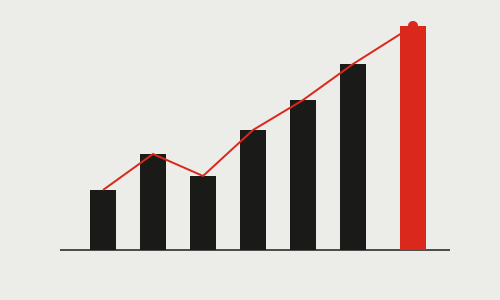
- · After financial sponsors held an 18% EV/EBITDA premium advantage over strategic acquirers in 2023, that gap has narrowed sharply to approximately 5% in 2025, as strategics sharpen their synergy discipline.
- · Cost synergies are priced most confidently by buyers; revenue synergies face heavy haircuts unless the commercial logic is already proven.
- · Swiss SME sellers and their advisors win not by citing strategic fit in broad terms, but by building an evidence-based synergy case on top of clean, trustworthy financials.
Every M&A process eventually features a buyer who describes your business as "a perfect strategic fit." This language is common, comfortable, and, on its own, worth approximately nothing in a bid price.
Strategic premiums are real — but they are earned through a specific mechanism: a buyer's capacity to generate value from an acquisition that exceeds what the business could produce on a standalone basis. That incremental value, when it is genuinely quantified and competently underwritten, justifies a bid above the financial-buyer floor. When it is not, the strategic label is simply decoration.
For Swiss SME owners preparing for a sale, and for the advisors structuring those processes, understanding the precise mechanics of how strategic buyers price acquisitions is not optional background reading. It is the basis on which a competitive or uncompetitive outcome is built.
For several years, private equity and other financial sponsors held a measurable valuation advantage over strategic acquirers. McKinsey's 2026 M&A research documents the scale of this gap: in 2023, financial sponsors were paying EV/EBITDA multiples approximately 18% higher than strategic buyers. By 2025, that gap had compressed to roughly 5%.
The compression did not happen because PE became less aggressive. It reflects strategic acquirers becoming more disciplined and confident in identifying, framing, and committing to synergy targets. McKinsey describes this as building a "synergy muscle" — a capability shift, not a lucky quarter.
For Swiss SME sellers, the implication is directly practical. If strategic buyers in your sector are recapturing ground from financial sponsors, the businesses most likely to benefit are those that make synergy extraction straightforward and credible. Sellers who arrive at a process with weak financials, opaque EBITDA, or uncertain customer transferability will not capture this improvement. Those who have prepared properly may.
Not all synergies are created equal in a buyer's model. Auxo Capital Advisors offers a useful taxonomy that reflects how acquirers actually apply confidence weights in their internal valuation work.
are the most aggressively priced category. These include duplicate overhead removal, facility consolidation, procurement leverage through combined purchasing volumes, and back-office deduplication. The reason buyers price these confidently is structural: cost lines are visible, ownership is assignable, and measurement post-close is straightforward. Announced cost synergies in 2024 and 2025 are already significantly exceeding the historical average of approximately 16% of a target's cost base, according to McKinsey's analysis — a signal that strategic buyers are raising their own internal ambitions.
attract immediate scepticism in buyer models. Cross-selling into the acquired company's customer base, channel expansion into new geographies, and product adjacency plays all appear compelling at the conference table. In practice, customer behavior is difficult to predict and even more difficult to contractually guarantee. Buyers typically haircut revenue synergy assumptions by 50% or more unless a proven route to market already exists and customer bases are demonstrably compatible. What makes this particularly interesting is that the median announced revenue synergy has tripled — from approximately 6% of target revenues in 2015 to 2019, to 17% from 2020 onward. Buyers are announcing larger revenue synergies, even while internally discounting them heavily. The gap between announcement and underwritten confidence is where negotiation complexity lives.
- · acquiring technical depth, certifications, specialized talent, or product extensions that would be slow or expensive to build organically — carry moderate pricing confidence. These are increasingly relevant in sectors like specialized manufacturing, IT services, and healthcare ancillaries, where capability gaps are real and organic development timelines are long.
, including balance-sheet optimization and improved capital allocation, are the least commonly emphasized category in direct pricing, though they are present in the background of most sophisticated buyer models.
A simplified framework for understanding how strategic buyers construct a bid looks like this:
Strategic Value = Standalone Enterprise Value + Underwritten Synergy Value – Risk Haircuts – Transaction Friction
The standalone enterprise value is not bypassed or assumed away. Buyers begin with normalized EBITDA, market comparables, precedent transaction multiples, and DCF analysis to establish a credible floor. As Auxo Capital's framework makes clear, if the earnings base is not trusted — if margins fluctuate without explanation, if cash conversion is inconsistent, if EBITDA normalization requires too many adjustments — the synergy case loses its foundation. A buyer cannot confidently price synergies on top of earnings they do not believe.
The real negotiation occurs in the middle of the formula: gross synergy potential, implementation costs, phasing of benefits over time, and the confidence discount applied to each category. Rarely does 100% of theoretical synergy value appear in the final bid. The buyer's internal model will show a full potential number; the external offer will reflect a conservative subset of that. This is not bad faith — it is rational risk pricing.
Leading strategic acquirers have formalized their synergy estimation process in ways that reduce guesswork and legal exposure simultaneously. Clean teams — typically independent consultants or ring-fenced internal personnel supervised by legal counsel — analyze supplier and customer overlaps, facility utilization, and cost-structure duplication without exposing sensitive competitive information to the acquirer's operational staff before deal signing. In larger transactions, this has become standard practice rather than a differentiator.
Post-close, McKinsey's research shows that acquirers with dedicated Integration Management Offices (IMOs), named synergy owners, and weekly KPI tracking against committed targets demonstrably outperform those without. The TSR data is specific: strategic acquirers that publicly announce and deliver against synergy targets outperform by 3.6% in total shareholder return, compared to -1.7% for those that do not publish targets. Execution infrastructure is not peripheral to the valuation conversation — it is the mechanism that makes the premium defensible to the buyer's own shareholders.
For sellers, this creates a practical evaluation criterion. Comparing competing offers on headline enterprise value alone is insufficient. A buyer with a credible integration track record, a named integration lead, and a clear synergy ownership structure is more likely to close and less likely to introduce post-signing complications than a buyer relying on optimistic projections and good intentions.
A headline enterprise value figure can appear compelling while actual seller proceeds are materially lower. Net debt adjustments, debt-like obligations (pension deficits, deferred liabilities, operating lease treatments), working-capital target mechanisms, earnout provisions, and rollover equity requirements all affect what a seller actually receives at close. Buyers are sophisticated at protecting themselves in the bridge from EV to equity value even when the headline number is strong.
Advisors serving Swiss SME sellers provide essential value by comparing competing offers on a cash-certain proceeds basis, not headline EV. Two offers at the same enterprise value can differ substantially in real terms depending on how the bridge is constructed. This is particularly relevant in transactions involving earnouts tied to revenue synergy milestones — instruments that shift risk from buyer to seller while leaving the headline number intact.
Swiss SMEs below the CHF 50 million EBITDA threshold that would typically attract investment-bank mandates compete for strategic buyer attention in a market where multiple candidates exist in parallel. The most active strategic buyers in adjacent Swiss sectors — industrials, B2B services, specialized manufacturing, healthcare ancillaries, IT services — frequently originate from Germany, France, and the broader DACH region.
These acquirers often carry structural advantages: lower cost of capital than independent PE, established procurement platforms that generate immediate cost synergies, existing cross-selling channels, and clearly defined geographic or capability gaps that a Swiss acquisition can fill logically. The question is not whether they could pay a strategic premium. The question is whether the specific business in front of them gives them enough confidence to do so.
Transferability is the operating concept here. Will key customer relationships survive the ownership change, or are they anchored to the current owner personally? Can the founding team transition cleanly, or does institutional knowledge sit in one person's head? Are systems and reporting sufficient for integration, or will the acquirer inherit a manual reconciliation project? These practical questions determine whether a strategically attractive sector narrative translates into a competitive offer or a cautious one.
The businesses that capture strategic premiums reliably share a common foundation: they have invested, typically over a two-to-three year horizon before any sale process, in financial hygiene, management depth, and operational transparency. Clean, auditable financials. A leadership team that functions independently of the founder. Customer relationships that are contractual or institutional rather than personal. Systems that produce reliable, timely reporting.
None of these characteristics creates the synergy case on their own. But their absence suppresses the strategic value calculation more aggressively than it would suppress a financial buyer's standalone cash-flow model. A strategic acquirer building a synergy case needs to trust the earnings base completely. Any doubt about that foundation reduces the premium they are willing to pay — and in many cases, it reduces it more than the equivalent doubt would affect a PE firm focused entirely on standalone performance.
The preparation investment is not primarily about making the business look better. It is about removing the friction that causes strategic buyers to apply larger risk haircuts than the business warrants.
When advisors and sellers enter a strategic process with explicit, evidence-based synergy framing — here are the cost overlaps, here is the timing of realization, here is the implementation cost, here is what could go wrong — they shift the negotiation from abstract multiple discussion to specific value components. That specificity is where credible premium is defended.
Vague strategic enthusiasm, however genuinely felt, does not hold up under a buyer's diligence. The acquirer's internal team will apply haircuts regardless. The question is whether the seller's preparation reduces those haircuts to a fair level, or whether they are applied generously because the seller left the quantification work entirely to the buyer.
In M&A, whoever does the analysis tends to set the terms of the conversation. Sellers who arrive with their own credible synergy evidence are better positioned to challenge aggressive discounts. Sellers who arrive with only a sector narrative are negotiating on the buyer's model alone.
This article draws on analysis from McKinsey's 2026 M&A trends report on strategic buyers and synergy execution and Auxo Capital Advisors' framework for how strategic buyers value companies. It is published as market observation and does not constitute investment advice or a solicitation to transact.